


Reading a Race Bracket: How to Follow Your Pack's Derby Without Getting Lost
Event Coverage | October 1, 2026
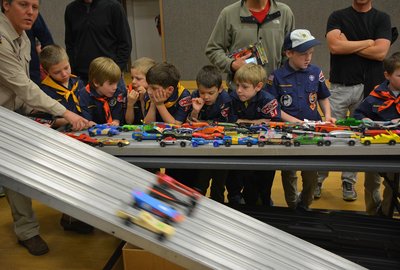
Race day arrives and suddenly there is a poster taped to the wall covered in crossing lines, letters, and numbers. Parents crowd around it trying to figure out whether their kid is still in it. If that sounds familiar, you are not alone. Most pinewood derby events run on some version of a double-elimination bracket, and it is genuinely confusing the first time you see one. Here is how to read it without a degree in tournament theory.
The basic idea is fairness. In a double-elimination format, a car is not out of the competition until it has lost twice. That means one bad run, one sticky wheel, one lane that happens to be a little slower, does not end a kid's day. They drop into a second bracket, sometimes called the losers bracket or the consolation bracket, and keep racing. Lose a second time and the day is over. Win enough in that second bracket and you can actually fight your way back into the final.
How the Lines Connect
Find your car's number on the bracket. Follow the line to the right. If you win, you follow the upper line into the next round of the winners bracket. If you lose, you follow the lower line down into the second bracket. That is the whole trick. Every match on the sheet has two lines leaving it, and which one you take depends entirely on the result. Once you internalize that, the poster stops looking like a subway map.
The letters you see are usually shorthand. W means winner, L means loser, and you will often see something like W1 or L2 referring to the winner or loser of a specific match. Some brackets use numbers only, where match 5 feeds its winner into match 9 and its loser into match 11. Ask the person running the table to point to your car's next race if you are unsure. Volunteers would much rather answer that question than deal with a confused family later.
Lane assignments are the other thing to watch. Most tracks have two to six lanes, and cars typically run once in each lane so that any lane-to-lane variation evens out. If you see your car listed in lane three for the next heat, that is normal. It does not mean anything is wrong. The goal is that every car runs the same number of times in each lane before the results are compared.
What to Watch Beyond the Bracket
Brackets tell you who advances, but they do not always tell you who is fastest. Many packs also run a separate timed competition where every car gets a set number of runs and the best average time wins, independent of the bracket. That format rewards consistency and tends to be a better measure of the build itself. If your pack uses both, pay attention to which one your family cares about. A car can go out early in the bracket and still take home a speed trophy from the timed side.
The most important thing to remember is that the bracket is a tool for organizing fun, not a verdict on your kid. Stand near the track, cheer for every car, and help the younger racers find their next heat. The families who have the best race day are almost never the ones who studied the bracket the hardest.
-

-
Graphite, Oil, or Nothing at All: Choosing a Lubricant for Your Pinewood Derby Axles
Sep 21, 2026Car-Building Tips

-
When Your Car Wins the Pack but Loses the District: A Post-Race Autopsy Guide
Sep 23, 2026Event Coverage

-
Workshop Safety for Young Builders: Tools, Glue, and Keeping Fingers Intact
Sep 15, 2026Race Results

-

-
The Design Award Playbook: How to Build a Car That Looks as Good as It Runs
Aug 27, 2026Car-Building Tips

-

-
Reading a Race Bracket: How to Follow Your Pack's Derby Without Getting Lost
Oct 3, 2026Race Results

-

Pinewood Pulse

Hitting the maximum weight is only half the job. Where that weight sits changes how the car behaves on the track.